/ Home / Attractions / Cementiri de MontjuïcPrint version
Cementiri de Montjuïc
.JPG.medium.jpg)  (2).JPG.medium.jpg) .JPG.medium.jpg)
|
|
Historic information
Montjuïc Cemetery, which is also known as the South-West Cemetery due to its location, was opened on 1st March 1883. It was designed by the architect Leandre Albareda, who also supervised the building work and built some of the important mausoleums in the cemetery. The first person to be buried here was Josep Fonrodona Riva, a Cuban of Spanish descent who was born in Matanzas, as is stated on his epitaph. Rius i Taulet was mayor at the time and he was the man behind the Ciutadella Park and many other initiatives which changed Barcelona for the good in the 19th century.This is one of the city’s biggest cemeteries and the only one that can be seen from the sea. This vast necropolis, with its broad avenues, contains over 150,000 graves, many of them of great architectural and sculptural interest, and is a perfect replica of the architecture of the Example district. The finest examples of Catalan art nouveau, modernisme, and the later noucentisme, can be found in both places. The people of Barcelona can feel proud of this cemetery that faces the Mediterranean, the sea that links cultures and showcases the history of the world.
In order to know the zone better
One of the most outstanding redevelopment projects carried out in the cemetery in recent years is the Fossar de la Pedrera. The former common grave was landscaped by the architects Galí and Quintana, and converted into a park of cypresses and ivy with grassy areas, benches and columns. The tomb of Lluís Companys, the President of the Catalan Government who was executed at Montjuïc Castle (1940), very near the burial ground, stands on this 6-kilometre site, near a small pond.In the 1970s, the cemetery was practically full, and people could only be interred in family-owned burial plots or recesses. Among the many eminent figures buried in the cemetery are the painters Ramón Casas and Joan Miró, the writers Josep Maria de Sagarra, Joan Salvat-Papasseit, Jacint Verdaguer and Joan Vinyoli, the composers Isaac Albeniz and Frederic Mompou, and Joan Gamper, the founder of Barcelona Football Club.Modernista architecture is represented in the many mausoleums and family vaults which show the collaboration between architects, sculptors and marble masons. The necropolis features magnificent works in Montjuïc stone, marble, bronze, wrought iron and superb metalwork by Masriera-Campins. The most prestigious artists and architects of the time took advantage of the fact that the upper middle classes of the time had unlimited budgets for their tombs, enabling them to create works of great imagination and beauty.The cemetery is near the other attractions on Montjuic Hill, such as the sporting facilities built for the Olympic Games, known as the Olympic Ring, which includes the Olympic Stadium, the Palau Sant Jordi and the Picornell Swimming Pools.
|
Scene description
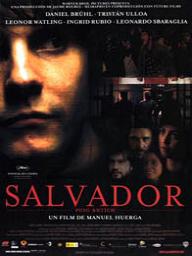
Salvador (Puig Antich)
.JPG.medium.jpg) .JPG.medium.jpg) .JPG.medium.jpg)
Montjuïc Cemetery: A pan shot shows Salvador’s friends and relatives at the cemetery while his coffin is being placed in the burial niche. The expressions of pain and sorrow on the faces of the mourners are shown in the close-up shots of that rainy day. A series of shots show the exterior of the cemetery, through the closed iron gates at the main entrance, with a crowd of people protesting, despite the heavy police presence. The sequence and the film end with the police charging into the crowd, with the cemetery as the backdrop and a magnificent closing shot of red roses scattered on the rain-washed ground.
|
Did you know that...
In the morning of 2nd March 1973, a hearse carrying the body of Salvador Puig Antich, guarded by four police vans, left the Model Prison for Montjuïc Cemetery. Their hopes dashed, friends, relatives and lawyers followed the cortege to the cemetery which was overrun by Franco’s police. Only Salvador’s sisters, Oriol Arnau and Josep Lluís Pons’ uncle were allowed at the graveside during the burial, unlike the scene in the film which shows a large group of people.
The voice we hear off screen during the burial is reading part of a letter Imma Puig, Salvador’s sister, wrote to her brother Joaquim. The song at the end of the film is I si canto trist by Lluís Llach, which he composed after Salvador’s death. One of the demonstrators shouts “Your death won’t be in vain”. Certainly, the protests, which were few and far between before the execution, grew in number afterwards. For instance, on 2nd March, over 1,500 people gathered at the cemetery in defiance of the police presence. From that moment on, the name Salvador Puig Antich was etched in the hearts and minds of the thousands of people who took to the streets to protest at his death. He is buried modestly in burial niche 2737 (columbarium 14). |
The Barcelona of "Salvador"
/
Cementiri de Montjuïc
 |
Barcelona Movie Walks '26 |  |